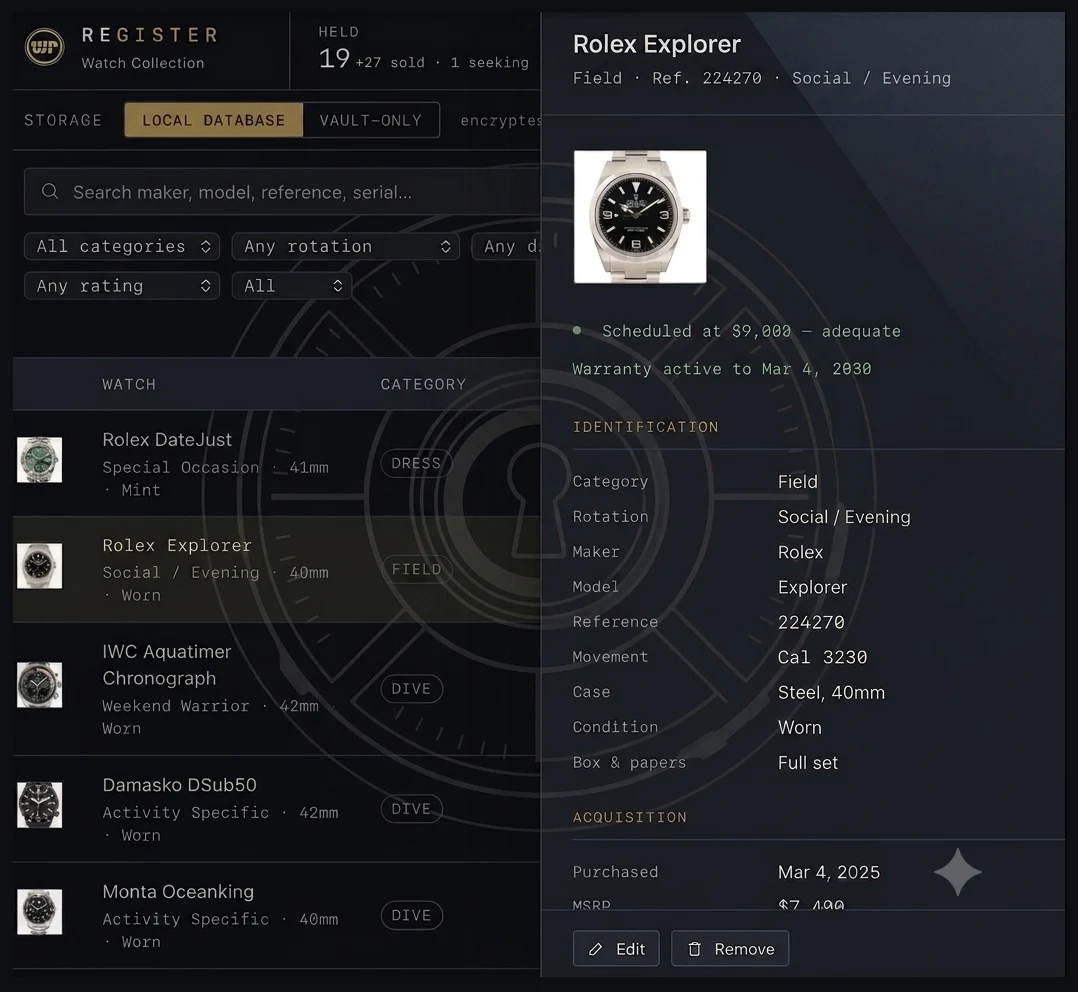
Watch Register is a private register for significant collections —
appraisals, service history, provenance and succession, held encrypted
on your own machine. There is no cloud, no account, and no company
holding a copy of what you own.
For macOS and Windows · A one-time licence, not a subscription
Discretion
A collection worth insuring is worth keeping private.
Most collection apps ask you to upload photographs, serial numbers and
valuations to somebody else’s server. That creates a single,
attractive list of what you own and where you live. Watch Register was
built so that list cannot exist anywhere but your own machine.
No servers
There is nothing to breach.
No account to create, no password to be leaked in someone else’s
data breach, no vendor database quietly holding an inventory of your
watches. Your register exists on your machine and nowhere else.
Offline by design
The application cannot send your data anywhere.
This is not a setting you have to trust us to honour, and not a
promise of restraint. The application is built without any network
capability at all — no connection to make, no address to send to. It
works exactly the same on a laptop that has never been online.
Encrypted at rest
A stolen laptop reveals nothing.
Everything — watches, values, serial numbers, photographs and attached
documents — is stored as a single encrypted file. Someone who takes
the machine, removes the drive and reads it directly gets unreadable
data. There is no lock to pick, because the information itself is
scrambled.
Confidential
We cannot see your collection, even if asked.
The key that opens your register is derived from a passphrase only you
hold, and it never leaves your machine. There is no copy in escrow and
no mechanism by which we could produce your data for anyone — a support request, an insurer, or a subpoena. We simply
do not have it.
It began as one collector’s own record. That is why it handles the
tedious, consequential things carefully and none of the flashy things at
all.
01
Appraisals and insurance schedules
Produce a scheduled property inventory — every piece, reference, serial
number, appraised value and insured value — to hand to an underwriter or
attach to a claim. Anything worth more than it is covered for is flagged
before you find out the hard way. Formal appraisals, invoices and
warranty cards attach to the record and are encrypted alongside it.
02
Service history
Log every service, the house that performed it, what it cost and when
the next is due. A complete, dated service record is part of what a
piece is worth — and it is among the first things a serious buyer or an
estate appraiser will ask to see.
03
Provenance
Where a piece came from, who owned it before you, the box and papers,
the auction lot, the story. Held with the record rather than in a drawer
of receipts, and encrypted with everything else.
04
Succession
An estate register prints what your executor will actually need: what
these pieces are, what they are worth, which are promised to a named
person and which may be sold. You can also leave an encrypted copy of
the whole register with your estate documents.
05
An honest position
Two figures, deliberately kept apart. What the collection might be worth
today, from your own valuations — an estimate. And what actually
happened when you sold: hammer price, less commission, less what you
paid, duties, shipping and every service in between.
06
The hunt
Mark a piece as sought and it sits in the register as part of the chase
— excluded from every total and from both printed documents, because you
do not own it yet. Record the purchase and it joins the collection on
its own.
A worked example — why the second number is the real one
A watch bought for $4,000, serviced twice for $1,950, sold for $6,500 with
$780 in fees looks like a $1,570 gain. It is actually a $380
loss. The disposition report shows both figures side by side,
because only one of them is true.
Protection
One key, held only by you.
The register is protected with AES-256 encryption — the standard used to
protect classified government information and banking systems.
Your passphrase
The only thing that opens it.
The application opens locked and stays locked until you enter it. It
locks itself again on an idle timer, and locking discards the key
entirely — a locked register is not a screen drawn over readable data.
There is nothing to read.
Recovery key
A second way in, on paper.
A printable recovery key is shown once during setup. It opens the
register independently of your passphrase, and is meant to be written
down and stored where your important documents live — a safe, a
deposit box, or with your attorney.
Backups
An encrypted file you control.
Export the entire register — photographs and documents included — as a
single encrypted file. Keep it on a drive in a safe, or hand it to an
executor. It is unreadable without your passphrase, so where it rests
matters far less than it otherwise would.
There is no reset
No backdoor, no escrow, no support line that can let you back in. If you
lose both your passphrase and your recovery key, the register cannot be
opened by anyone, permanently. That is the same property that makes a
stolen laptop survivable: any door that could let you back in could let
someone else in too. We would rather tell you this now than at the worst
possible moment.
A collection like this gets reviewed a few times a year — checking
provenance, confirming coverage, deciding what happens to it — not checked
on the subway. That is a sit-down task, and building a synced companion for
it would mean solving a different problem than the one this app was built
to solve.
What syncing to a phone requires
A server holding a master copy, so two devices have something to compare against
Or that same server resolving conflicts when you edit from both at once
What Watch Register does instead
One copy, on one machine, that has never been reachable from anywhere else
Moving it is a deliberate act — export a vault file, carry it yourself — never a background sync you stopped watching
A companion app to look up a single piece — serial, insurance, photos —
would be a separate product with its own storage, and might happen later.
It would not be a synced copy of this one.
More in the FAQ →
Licensing
Bought once. Yours to keep.
Watch Register is a proprietary desktop application for macOS and
Windows, sold under a one-time personal licence. Not a subscription, and
not a service that can be switched off out from under your records —
because it does not depend on anything we run.
Use inside a dealership, auction house, or any other business requires a
separate commercial licence.
legal@watchregister.app.
Personal licence
Coming Fall 2026
$99one-time · lifetime licence
Perpetual for the product generation you buy, including updates within
it. Sold through a merchant of record, which handles sales tax and VAT
and issues your licence key.